Can I Use a Framing Nailer for Siding?
Yes, you can use a framing nailer for siding when the boards are thick enough to hold a framing nail without splitting or crushing. It's a poor fit for thin lap planks, vinyl and fiber cement, where a smaller head and closer depth control do the job better.
On this page (9 sections)
- Can I use a framing nailer for siding on a whole house?
- What siding materials can take a framing nail?
- Why does a framing nailer damage thin siding?
- Can I control depth on a framing nailer for siding?
- What should you use instead for thin lap and trim?
- Does nail angle and collation matter for siding?
- How do you test a framing nailer on a scrap board?
- What about the sheathing layer and roof decking?
- What's the decision rule for siding and a framing nailer?
Yes, you can use a framing nailer for siding when the boards are thick enough to hold a framing nail without splitting or crushing. It's a poor fit for thin lap planks, vinyl and fiber cement, where a smaller head and closer depth control do the job better.
The short answer depends on what kind of siding you mean. Structural sheathing, thick rough-sawn boards and some cedar lap can take a framing nail.
Trim-like planks and manufactured panels call for a finish nailer or a siding-specific gun.
Can I use a framing nailer for siding on a whole house?
For the sheathing layer under the siding, yes, and that is the framing nailer's real job. For the visible siding boards, only when they're thick and solid enough to hold a 0.131 in shank.
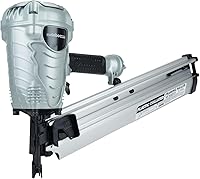
The Metabo HPT NR90AES1 drives 2 in up to 3-1/2 in plastic collated framing nails, which covers OSB, plywood and 5/4 decking boards. It weighs 7.5 lb, so you can run it along a wall for a few hours without your arm dropping.
Metabo HPT gives it a 5-year tool warranty and a tool-less depth adjuster, which matters because flush-driving into a soft board is where damage starts. The selective actuation switch lets you move from bump firing on sheathing to single-fire on any siding you care about.
That combination, full head and heavy shank, is exactly why it belongs on the structure and not on a 5/8 in lap board. Know the limits before you point it at the face of a house.
What siding materials can take a framing nail?
Thick wood is fine, manufactured panels and thin planks are not. Here is roughly what each siding type expects from a nail.
- Structural sheathing (OSB, plywood, roof deck): framing nailer, no question.
- 1 in or thicker cedar or pine lap, or board and batten: workable with a framing nailer on a scrap test, but a finish nailer gives a cleaner result.
- 5/4 and thicker deck boards used as siding: framing nailer fits the thickness.
- Vinyl and aluminum siding: never. They need a slotted hole and a loose fit.
- Fiber cement lap: no. It cracks easily, and the maker's spacing and head rules assume a siding nailer.
- Engineered wood (LP SmartSide and similar): no. Use the nailing schedule the maker publishes.
The pattern is simple: if the board is a structural piece of wood, the framing nailer works. If the board is a finished skin, it wants a smaller fastener.
Why does a framing nailer damage thin siding?
The full round head and the 0.131 in shank put too much metal and too much pressure into a thin board. Two things go wrong at once.
First, the head is wide, so it sits on the surface like a coin. On a soft plank it crushes the wood around the nail instead of setting into it.
A finish nailer drives a small head that sinks or sits almost flush.
Second, the shank is thick. In a 5/8 in board, a 2-3/8 in framing nail is longer than the board is thick plus the sheathing, so it can poke through the back or hang up on a stud edge and bend.
Nail placement is the third issue. Framing guns are built to fire fast along a stud line, and a fast bump-fire rhythm on 3/4 in cedar will overdrive one board and split the next.
Can I control depth on a framing nailer for siding?
Yes, to a point. The NR90AES1 has a tool-less depth adjustment for countersink or flush drive, and that dial is your main control.
Turn the air pressure down as well, because the tool is meant to sink nails into framing lumber, and siding is much softer.
Lower the regulator to around 70 to 80 psi on soft wood and test on a cut-off. Then close the depth dial until the head sits just flush.
Bump fire is for sheathing only. Switch the NR90AES1 to sequential mode on any siding board you plan to look at, so each shot needs a deliberate trigger pull.
That much control still won't fix a thin board. If you find yourself backing off constantly, that is the tool telling you it's the wrong one for the job.
What should you use instead for thin lap and trim?
A 15 or 16 gauge finish nailer. These drive a small head that hides well and a narrower shank that splits less.
Both work well on lap siding up to about an inch thick.
The Metabo HPT NT65MA4 fires 15-gauge angled DA nails from 1-1/4 in to 2-1/2 in and weighs 4.2 lb. That short nail and light body suit a 3/4 in lap plank far better than a framing gun, and the angled magazine gets into corners where a straight one rubs the wall.
Metabo HPT backs it with a 5-year warranty, and the selective actuation switch and depth dial let you set a flush drive and stay in full-sequential mode. The 360-degree exhaust port keeps air off your face and off a freshly painted board.
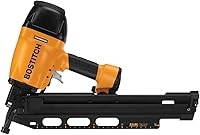
The Bostitch BTFP71917 is the other sensible pick, in 16 gauge. It drives 1-1/4 in to 2-1/2 in nails, has a dial-a-depth control and a selectable trigger, and the oil-free design avoids oil marks on bare wood.
The kit bundles a 1/4 in air fitting, a case and extra no-mar tips, which helps if you're setting up a gun just for siding trim. Bostitch covers it with a 7-year limited warranty.
If you own neither, learn the how to use a framing nailer basics first, since setup, pressure and storage carry over to the smaller guns.
Does nail angle and collation matter for siding?
Yes, 21 vs 30 degree changes the tip and the access, but not the head or shank. A 21 vs 30 degree framing nailer boils down to collation and where the magazine points, which matters in a tight corner along a wall.
The NR90AES1 is a 21 degree plastic collated gun, so it takes 21 degree plastic collated nails. If you already run 30 degree paper collated nails, check the magazine before you buy anything new.
A 21 degree framing nailer fits most siding work on walls, since the point angles into the stud rather than away from it.
Angle also changes what happens near a corner. A 21 degree tip fires close to the nose, while a 30 degree tip sits further back, which is why some installers prefer one over the other on cladding.
None of this fixes a thin board. The angle helps with aim and reach, not with head size, and head size is what ruins lap siding.
How do you test a framing nailer on a scrap board?
Drive one nail into a cut-off of the same siding before you touch the wall. It's the only reliable check for split, overdrive and depth.
- Set the same air pressure you plan to use on the wall.
- Nail into a scrap strip at the same angle and spacing you'll use.
- Look for a crushed face, a blown-through head or a split along the edge.
- Move the nail farther from the edge and try again, since edge splits are the usual failure.
- Then shoot a second nail about 1 in from the first to simulate a stud pattern.
If every attempt crushes the face, stop and change tools. That first scrap test costs a minute and saves a whole board.
What about the sheathing layer and roof decking?
This is where the framing nailer earns its place on a siding job. The sheathing goes up before the siding, and the NR90AES1 covers it, since Metabo HPT lists roof decking, wall sheathing and sub flooring among the uses.
Nail spacing and length come from your local code, and a 2-3/8 in nail is common for 1/2 in sheathing into framing. Bump fire is safe here because a crushed sheathing face hides under the siding.
The 21 degree plastic collated nails feed easily and the 7.5 lb body is light enough for a day on a wall. If your next layer is roof deck, the same gun is fine, though a different tool suits membrane work, as explained in can I use a brad nailer for roofing.
What's the decision rule for siding and a framing nailer?
Use the framing nailer on sheathing, thick boards and deck-thickness siding, and use a 15 or 16 gauge finish nailer on the thin lap and trim. That's the answer to whether you can use a framing nailer for siding: partly yes, partly no.
Pick the NR90AES1 for the structure layer, for 1 in or thicker boards and for board and batten. Pick the NT65MA4 or the Bostitch kit for lap planks, trim and anything you want to look clean when it's painted.
If the board flexes in your hand and you can see the nail head through it, the framing gun stays in the truck. That rule will save more boards than any depth setting.
Check the thickness against the nail length, then do the scrap test. If the scrap crushes or splits, step down to a finish nailer and finish the wall.
Frequently asked questions
What nail gun should I use for lap siding?
A 15 or 16 gauge finish nailer with a 2-1/2 in nail suits most lap planks up to about an inch thick. It sets a small head that hides well, and the depth dial keeps the nail from breaking the face.
Will a framing nailer split a 1-inch cedar board?
It can. A 0.131 in shank plus a full round head drives a lot of metal through soft wood, and near an edge that splits quickly.
Test a scrap piece first, stay back from the ends, and angle the nail slightly.
Do I need a different nailer for roof decking?
No. Structural sheathing and roof decking are where a framing nailer belongs, and a 2-3/8 in nail in most codes is driven in one pass.
Check your local code for ring shank and spacing.
Can a framing nailer overdrive siding?
Yes, and it's a common problem on soft boards. The full head plus the tool's weight crushes the surface, so lower the air pressure, back off the depth setting, and bump-fire less on delicate planks.