Brad Nailer vs Finish Nailer: What's the Difference?
A brad nailer drives thin 18-gauge nails for small trim and detail work, while a finish nailer drives thicker 16-gauge nails that hold heavier trim like baseboards and casing. Pick the brad nailer for delicate pieces and the finish nailer when you need real holding power.
On this page (8 sections)
- What is the difference between a brad and finish nailer?
- How does nail gauge change the hole and the hold?
- When should you use a brad nailer?
- When should you use a finish nailer?
- Which nailer should you buy first?
- How do you match the nail size to the trim?
- How do you set depth and avoid marks?
- Which tool is right for your next trim job?
The difference between a brad and finish nailer comes down to two things: the gauge of the nail and how much holding power that nail gives you. A brad nailer shoots thin 18-gauge nails for small, delicate trim.
A finish nailer shoots thicker 16-gauge nails that hold heavier molding in place.
That one gap in nail size changes which tool you reach for on a given job. Get the match right and the trim stays tight with a hole you can hide.
Get it wrong and you're either splitting thin wood or watching a baseboard pull away from the wall.
What is the difference between a brad and finish nailer?
The core difference is nail gauge: 18-gauge brads versus 16-gauge finish nails. The bigger the gauge number, the thinner the nail, so an 18-gauge brad is smaller in diameter than a 16-gauge finish nail.
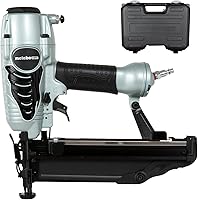
The Metabo HPT NT50AE2 accepts 18-gauge brads from 5/8 in up to 2 in. The Metabo HPT NT65M2S takes 16-gauge finish nails from 1 in up to 2-1/2 in.
That length range matters too, since longer and heavier trim needs the longer, thicker nail.
Both tools look similar and use the same basic motion. The head size, the hole left behind and the holding strength are where they part ways.
How does nail gauge change the hole and the hold?
A thicker 16-gauge nail holds more weight, and an 18-gauge brad leaves a smaller hole. The trade-off is simple: more holding power means a bigger hole to fill, and a smaller hole means less grip.
A 16-gauge finish nail has more metal in the shaft, so it resists pull-out better under heavy molding. That's why baseboards and casing call for a finish nailer.
An 18-gauge brad has a slim shaft that's easier to hide but offers less resistance when a board wants to bow or pull away.
For painted trim, the hole size matters. A 16-gauge hole usually needs wood filler and sanding before paint.
An 18-gauge hole is small enough that many painters just fill it with a dab of putty.
When should you use a brad nailer?
Use a brad nailer for small, thin or delicate trim where the hole needs to stay small. Shoe molding, quarter round, thin decorative strips, panel edges and cabinet face frames are common brad jobs.
The light weight helps here. The Metabo HPT NT50AE2 weighs only 2.2 lb, so you can hold it at odd angles for long stretches without arm fatigue.
Its no-mar tip also protects soft or finished surfaces from marks.
A brad nailer is the safer tool on thin stock. An 18-gauge brad is less likely to split a narrow strip than a thicker finish nail.
If you're working near the edge of a thin board, that margin matters.
If you're unsure whether a brad nailer can handle the piece in front of you, read can I use a brad nailer for trim before you start.
Which brad nailer fits most trim jobs?
The Metabo HPT NT50AE2 suits readers who want a light pneumatic brad nailer for everyday detail trim. It's a good match for shoe molding, cabinet trim and small decorative pieces.
Its selective actuation switch lets you pick bump fire or sequential fire. The tool-free depth dial helps you set the nail head flush in different woods, and the reload indicator warns you when the magazine is running low.
Metabo HPT backs it with a 5-year warranty.
Skip it if you don't have a compressor or you work in spots where an air hose gets in the way. In that case a cordless brad nailer is the better fit.
Which cordless brad nailer suits hose-free work?
The DeWalt DCN680B is the pick for trim work where a hose would snag or you have no compressor. It's battery powered, so there's no gas, compressor or hose to deal with.
Its brushless motor is built for runtime and durability, and the micro nose improves your line of sight for placing nails. The tool-free depth adjustment, jam release and selectable trigger cover the setup steps you'll repeat on every job.
DeWalt's low nail lockout also helps prevent dry firing and marks on the work.
The trade-off is that you're buying into a battery platform. If you already own DeWalt 20V MAX batteries, the bare tool makes more sense than starting a new system.
When should you use a finish nailer?
Use a finish nailer for baseboards, casing, chair rail and heavier molding that needs holding power. A 16-gauge nail bites deeper and holds a wide board tight against the wall.
The Metabo HPT NT65M2S takes 16-gauge nails from 1 in to 2-1/2 in and weighs 3.7 lb. It's built for installing molding, chair rail and cabinetry.
The tool-free depth adjustment helps you set the head cleanly in different materials.
A finish nailer is also the right call when a board has some tension in it. A thicker nail resists the pull that makes baseboards gap at the top edge.
For longer runs of molding, that grip is what keeps the line tight.
Our guide to the best 16 gauge finish nailer covers more models if you're shopping this category in detail.
How is a finish nailer different from a framing nailer?
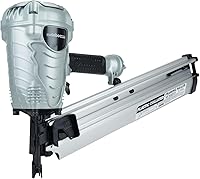
A finish nailer is a trim tool, while a framing nailer drives much larger nails for structural work. The finish nailer's 16-gauge nails are thin next to the thick nails a framing gun uses.
That size gap is why the two tools don't overlap. A framing nailer would split trim, and a finish nailer can't carry the load of a wall frame.
If you're sorting out that choice, finish nailer vs framing nailer breaks down the differences.
Which nailer should you buy first?
Buy a finish nailer first if most of your work is baseboards and casing, and a brad nailer first if you mostly do small detail trim. Most trim jobs lean toward baseboards, so the finish nailer is the more useful first purchase for many people.
The Metabo HPT NT65M2S is the stronger all-round pick for general trim. Its 16-gauge nails hold wide boards, and its 2-1/2 in maximum length covers common baseboard and casing stock.
The trade-off is a bigger hole to fill and a little more weight at 3.7 lb.
If your work is fine detail on cabinets or thin strips, start with the brad nailer instead. The NT50AE2 covers that ground at a light 2.2 lb.
Many trim carpenters end up owning both once the work adds up.
How do you match the nail size to the trim?
Match the nail length so it goes through the trim and into the wall or stud by about an inch. Too short and the nail won't hold; too long and it can poke through the back.
For baseboard, a 2 in to 2-1/2 in 16-gauge nail is a common match. For shoe molding or thin strips, a 5/8 in to 1-1/4 in 18-gauge brad usually fits.
Check the thickness of the piece plus the depth you need into the wall.
Also think about the material. Hardwoods and dense trim hold a nail better and can take a thicker gauge.
Soft or thin stock calls for the smaller brad so the wood doesn't split.
How do you set depth and avoid marks?
Set the depth dial so the nail head sits just below the surface, and use a no-mar tip on finished work. Both Metabo HPT models have tool-free depth adjustment for this.
Test on a scrap piece of the same trim before you start. Adjust the dial until the head is flush or slightly sunk, then lock in that setting.
A head left proud catches sandpaper and paint, while one driven too deep crushes the wood fibers.
The no-mar tip on both tools protects the face of the trim from the nose. Keep the nose flat against the surface and don't rock the tool as you fire.
For a full walkthrough of the technique, see how to use a finish nailer for baseboards and trim.
Which tool is right for your next trim job?
The answer depends on what you're nailing. Pick the brad nailer for thin, small or delicate trim, and the finish nailer for baseboards, casing and heavier molding.
That's the practical difference between a brad and finish nailer in one line.
The Metabo HPT NT65M2S is the best overall pick for most trim work, because 16-gauge nails hold the boards people nail most often. The NT50AE2 is the better fit when the piece is small or thin and you want a light tool.
The DeWalt DCN680B is the choice when a hose would get in your way.
If you'll do a range of trim, plan to own both tools over time. Start with the one that matches the bulk of your work, and add the other when a job calls for it.
Frequently asked questions
Is a 16-gauge finish nailer too much for small trim?
Often yes. A 16-gauge nail leaves a visible hole that needs filling, which is a problem on thin or painted detail work.
An 18-gauge brad nailer leaves a smaller hole and is the safer choice for small pieces.
Do I need both a brad and a finish nailer?
If you do a mix of trim work, yes. Many trim jobs use a finish nailer for baseboards and casing and a brad nailer for shoe molding and delicate pieces, so the two tools cover different jobs.
Which is better for cabinet work, a brad or finish nailer?
A brad nailer is the more common choice for cabinet trim and face frames because the small 18-gauge hole is easier to hide. A finish nailer is better when the cabinet part needs more holding strength.