Finish Nailer vs Framing Nailer: Key Differences (November 2026)
Choose a finish nailer for trim and a framing nailer for structural wood projects. Their nail lengths and intended jobs differ, so match the tool to the material and fastener your project needs.
On this page (6 sections)
Choose a finish nailer for trim and a framing nailer for structural wood projects. In a finish nailer vs framing nailer comparison, the key differences are nail type, length and the work each tool is made to do.
A finish nailer suits jobs such as molding, chair rail, cabinetry, casing and baseboards. A framing nailer takes longer framing nails for work such as flooring, trusses, roof decking and wall sheathing.
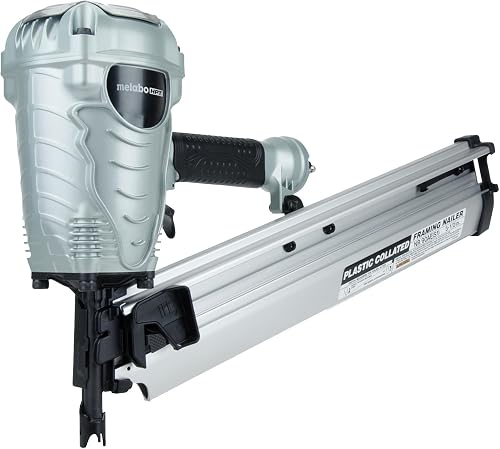
The NT65M2S accepts 1–2.5 in, 16-gauge finish nails and weighs 3.7 lb. The NR90AES1 accepts 2–3.5 in plastic collated framing nails and weighs 7.5 lb.
 Best for interior trim
Metabo HPT NT65M2S 16 Ga Straight Finish Nailer
 Best for framing projects
Metabo HPT NR90AES1 21 Degree Framing Nailer
Finish nailer vs framing nailer: what is the main difference?
A finish nailer joins trim and other finish pieces; a framing nailer joins framing and other structural wood. Their different fasteners reflect those different jobs.
A finish nail’s smaller gauge leaves a more modest hole in visible trim than a framing nail. A framing nail is longer and intended for thicker pieces of wood that need a stronger connection.
The NT65M2S drives 16-gauge finish nails from 1 to 2.5 in. The NR90AES1 drives plastic collated framing nails from 2 to 3.5 in.
These ranges overlap at 2 to 2.5 in, but that does not make the nails interchangeable. The gauge, collating and intended use still matter.
For a broader overview of tool types and their uses, read our guide to types of nail guns. If your project needs a framing tool, see our framing nailer guide.
Which nailer should you use for trim?
Use a finish nailer for baseboards, casing, molding, chair rail and cabinetry. It drives finish nails suited to fastening visible pieces while leaving a smaller hole to fill.
A 16-gauge finish nailer is a common choice for heavier trim pieces. Check the project instructions and material thickness to choose a nail long enough to hold without coming through the other side.
The NT65M2S has tool-free depth adjustment to help set how far nails sit in different materials. Its no-mar tip protects the workpiece from unintended marks.
The cordless DCN660B is another 16-gauge option for crown molding, casing and baseboards. It runs on a DEWALT 20V MAX battery and does not need a compressor or hose.
For more detail on the tool and technique, follow our guide to using a finish nailer for baseboards and trim. The 16-gauge vs 18-gauge nailer comparison can help when you're deciding which finish nail size suits your trim.
When does a framing nailer make sense?
Choose a framing nailer for framing, flooring, trusses, subflooring, roof decking and wall sheathing. These projects use longer framing nails to fasten thicker structural pieces.
The NR90AES1 accepts 2–3.5 in plastic collated framing nails. Its listed uses include flooring, truss build-up, subflooring, roof decking, wall sheathing and housing construction.
Framing tools are larger and heavier than finish nailers because their work and fasteners are different. The NR90AES1 weighs 7.5 lb, compared with 3.7 lb for the NT65M2S.
If you're installing a deck, shed or fence, check the project requirements and fastener guidance before choosing a tool. Our guide on how to use a framing nailer covers common framing tasks.
Can you use one nailer for both kinds of work?
A finish nailer and a framing nailer are not substitutes for each other. Use the nailer designed for the fastener and material in your project instructions.
A finish nailer’s 16-gauge nails work for finish pieces, but they are shorter and slimmer than many framing nails. A framing nail’s size can split trim, leave a larger hole or protrude through a thin piece.
Changing the depth setting does not change the nail type or tool’s intended job. If your project requires a specific fastener, use a compatible nailer and nail.
For more help matching a tool to a task, see what nail gun do I need for my project?. Follow the tool manual and project plans, and wear eye protection when operating either nailer.
What else should you compare before choosing?
Compare the required nail, work area and power setup before choosing between these tools. Nail length and project type should come first, followed by handling and compressor needs.
How do the nail lengths compare?
The finish nailer here accepts 1–2.5 in nails, while the framing nailer accepts 2–3.5 in nails. Match length to the thickness of the pieces being joined and the project’s fastener instructions.
The overlap in length does not mean one tool can drive the other’s fasteners. Confirm gauge and collation as well as length.
Which one is easier to handle?
The NT65M2S weighs 3.7 lb, while the NR90AES1 weighs 7.5 lb. A lighter tool may be easier to maneuver during detail work, but comfort also depends on your position and how long you use it.
Both pneumatic tools have selective actuation and depth adjustment. The NT65M2S has an adjustable exhaust port, while the NR90AES1 offers tool-less depth adjustment.
Should you choose a cordless finish nailer?
The DCN660B is battery powered and does not need a compressor, hose or gas cartridge. That can simplify setup for trim work where dragging an air hose would get in the way.
It is still a finish nailer, not a framing nailer. Its fasteners are 16-gauge angled finish nails from 1.25 to 2.5 in, so choose it only when those fasteners suit the job.
Which nailer should you choose for your project?
Pick a finish nailer for visible trim and a framing nailer for structural wood work. Then confirm the required fastener type and length before buying.
Choose the NT65M2S when you want a light pneumatic 16-gauge tool for molding, chair rail or cabinetry. Choose the NR90AES1 when the task calls for 2–3.5 in framing nails, such as roof decking or wall sheathing.
Choose the DCN660B if you need a cordless finish nailer for casing, crown molding or baseboards and already use compatible DEWALT 20V MAX batteries. For more comparisons, browse our nailer matchups.
Frequently asked questions
Can you use a finish nailer for framing?
A finish nailer is meant for trim and other fine finish work, while framing needs longer framing nails for structural wood connections. The NT65M2S accepts 1–2.5 in 16-gauge finish nails; the NR90AES1 accepts 2–3.5 in plastic collated framing nails.
Use the fastener and tool specified for the project.
Is a framing nailer too powerful for trim?
A framing nailer is generally the wrong fit for trim because its longer, larger framing nails can split or damage molding and remain too visible. Use a finish nailer for molding, chair rail, cabinetry, casing or baseboards, choosing nail length to suit the material and backing.
What is the main difference between a finish nailer and a framing nailer?
The main difference is the fastener and job: finish nailers drive smaller 16-gauge finish nails for trim, while framing nailers drive longer framing nails for structural wood work. Nail length, tool weight and the project material help you choose between them.
Can a cordless finish nailer replace a framing nailer?
No. The cordless DCN660B is a 16-gauge finish nailer for crown molding, casing and baseboards.
Battery power changes how the tool runs, but it doesn't turn a finish nailer into a framing tool.
For framing, choose a framing nailer with the right fasteners.


