Angled vs Straight Finish Nailer: Which to Buy? (November 2026)
Choose an angled finish nailer for tight corners and 15-gauge nails, or a straight nailer for a 16-gauge option and simpler access. Your work area, fastener needs and preference for pneumatic or cordless power should guide the choice.
On this page (6 sections)
Choose an angled finish nailer for tight corners and 15-gauge nails, or a straight finish nailer for a 16-gauge option and easier access on open trim. This angled vs straight finish nailer comparison comes down to magazine clearance, fastener type and whether you want pneumatic or cordless power.
The angled Metabo HPT NT65MA4 takes 15-gauge angled DA nails. The straight Metabo HPT NT65M2S and DeWalt DCN662B take 16-gauge finish nails, so the choice also affects which fasteners you use.
All 3 offer selectable actuation and depth adjustment. The Metabo HPT models are pneumatic, while the DeWalt runs on a 20V battery and avoids a compressor and hose.

 Best for pneumatic 16-gauge work
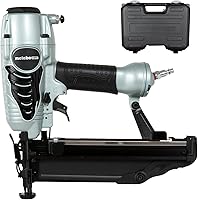
Metabo HPT NT65M2S 16 Ga Straight Finish Nailer
Angled vs straight finish nailer: what changes?
The magazine shape changes access, while the nailer also determines gauge and fastener style. An angled body can help you place nails in tight corners; a straight magazine suits areas with room in front of the work.
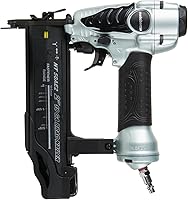
The NT65MA4’s angled magazine is designed for easier placement in tight corners. It accepts 15-gauge angled DA nails between 1-1/4 and 2-1/2 in long.
The 2 straight models accept 16-gauge finish nails. The NT65M2S handles lengths from 1 to 2-1/2 in, and the DCN662B from 1-1/4 to 2-1/2 in.
Don’t choose by the angle alone. Check the trim location and the exact nail type before buying, especially if you already keep one kind of finish nail on hand.
Does an angled finish nailer fit better in corners?
An angled magazine can make tight-corner placement easier. That can matter beside a wall, inside a cabinet or where casing meets another piece of trim.
The advantage depends on the tool’s body and the angle of your approach. Dry-fit the nailer near the work, with the magazine loaded only after following its instructions, to see whether your hand and tool fit.
For open baseboards and long casing runs, the magazine angle may matter less. A straight nailer can be a simpler match when there is clear space in front of the trim.
If you’re new to nailer types, our plain guide to nail guns explains how common tools differ by job. For a broader look at project and tool fit, see what nail gun you need.
Which nail gauge should you choose?
Pick the gauge based on the finish nail your project calls for and the fasteners you can readily buy. The angled tool here uses 15-gauge DA nails, while both straight tools use 16-gauge finish nails.
Gauge alone doesn’t tell you whether a nail fits. Collation and length matter too, so match all three to the nailer and the work.
The NT65MA4 takes angled DA nails from 1-1/4 to 2-1/2 in. The NT65M2S takes 16-gauge nails from 1 to 2-1/2 in, and the DCN662B takes 16-gauge nails from 1-1/4 to 2-1/2 in.
Use our guide to 16-gauge vs 18-gauge nailers if you’re still deciding whether 16 gauge suits the trim. For a wider overview of finish tools, browse finish nailers for trim.
Which power source fits your setup?
Choose a pneumatic nailer if you have a compatible compressor and hose; choose the cordless DeWalt if you want to work without them. The 2 Metabo HPT models use air, and the DCN662B is battery powered.
A pneumatic nailer adds a hose and compressor to the work area. Those can be convenient when already set up in a shop, but they take space and may need to move with you around a room.
The DeWalt uses a 20V battery and eliminates gas, compressor and hose. Its tool weighs 6 lb, compared with 4.2 lb for the angled Metabo HPT and 3.7 lb for the straight Metabo HPT.
The weight figures don’t include a full setup comparison, and the included components differ.
Check what you need to supply before buying. Our guide to using a finish nailer for baseboards and trim covers setup and safe fastening.
Which finish nailer suits your project?
Choose the NT65MA4 for tight corner access and 15-gauge angled nails, the NT65M2S for lighter pneumatic 16-gauge work, or the DCN662B for cordless 16-gauge use. Match the tool to your trim, power setup and preferred fastener.
Metabo HPT NT65MA4: best for tight corners
The NT65MA4 is the angled option in this comparison. Its magazine is designed for easier placement in tight corners, and the tool accepts 15-gauge angled DA nails.
It weighs 4.2 lb and has a selective actuation switch, tool-less depth adjustment and an integrated air duster. It’s a practical choice when corner access matters and you already have a pneumatic setup.
Metabo HPT NT65M2S: best for pneumatic 16-gauge work
The NT65M2S is the lightest tool here at 3.7 lb. It accepts 16-gauge finish nails from 1 to 2-1/2 in and includes tool-free depth adjustment, an adjustable exhaust and an air duster.
Choose it for molding, chair rail or cabinetry when you prefer a pneumatic nailer and a straight magazine fits the work area. It has a no-mar tip to help protect the workpiece from unintended marks.
DeWalt DCN662B: best for cordless access
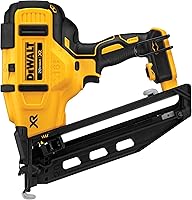
The DCN662B is the cordless straight option. It runs on a 20V battery, accepts 16-gauge straight finish nails from 1-1/4 to 2-1/2 in, and has a brushless motor.
Its tool-free trigger selection switches between sequential and contact actuation, while tool-free depth adjustment helps set nail depth. At 6 lb, it weighs more than either pneumatic tool, so consider that difference if you’ll hold it for long stretches.
What should you check before buying?
Verify the nail type, length range, power setup and working clearance before choosing. Those details can rule out a tool even when its broad category sounds right.
Start with the project instructions or trim plan. Confirm the required gauge and nail length, then check the angled DA or straight fasteners the nailer accepts.
Next, assess the work area. Look at corners, cabinet interiors and nearby walls, and leave room for your hand, the tool and the magazine.
Finally, check your air or battery setup. The Metabo HPT nailers need a compatible compressor and hose; the DeWalt avoids those but needs its 20V battery system.
For help selecting a finish nailer for a specific trim job, read our finish nailer vs framing nailer comparison. A framing nailer is meant for different fastening work, so don’t substitute one based only on nail length.
Angled or straight finish nailer: which should you buy?
Buy the angled NT65MA4 if tight-corner access and 15-gauge angled DA nails suit your work. Choose the straight NT65M2S for a lighter pneumatic 16-gauge tool, or the straight DeWalt DCN662B when cordless work without a compressor and hose is the priority.
Before ordering, confirm the fastener type and length your project needs, then compare them with the nailer’s accepted range. For help applying a finish nailer to trim, continue with our finish nailer use guide.
For safe setup, follow the tool manual and review our nail gun safety tips.
Frequently asked questions
Is an angled or straight finish nailer better?
An angled finish nailer is better when the magazine needs to reach tight corners, while a straight model can suit open trim runs and a 16-gauge fastener choice. Compare the exact nail gauge and collation each tool accepts, then consider whether your work area has room for a straight magazine.
What is the difference between 15-gauge and 16-gauge finish nails?
A 15-gauge nail is thicker than a 16-gauge nail. These tools also differ in nail type: the angled Metabo HPT takes angled DA nails, while the straight Metabo HPT and DeWalt take 16-gauge finish nails.
Match the nailer to your project and the fasteners you can source.
Do angled finish nailers use different nails?
Yes, the Metabo HPT NT65MA4 accepts 15-gauge angled DA nails from 1-1/4 to 2-1/2 in. Check nail angle, collation and length before buying fasteners, since a nail that has the right gauge but wrong collation may not fit.
Can a straight finish nailer reach corners?
A straight finish nailer can reach many trim areas, but the magazine may limit placement in a tight corner. The angled Metabo HPT is designed for easier placement and operation in tight corners.
Check the space around your trim before choosing.
Should you choose a pneumatic or cordless finish nailer?
Choose pneumatic if you already have a compatible compressor and hose, and cordless if avoiding that setup matters more. The two Metabo HPT nailers here are pneumatic; the DeWalt DCN662B is battery powered and eliminates the need for gas, a compressor and a hose.